Receive regular updates about SÜDPACK, our products and sustainability topics.

SPQ® enables SÜDPACK to combine efficiency, precision, and sustainability in industrial flexo and rotogravure printing. The technology is based on a standardized 7C color space (CMYK + orange, green, and violet) with precise color management across an integrated process and production chain. This ensures high color fidelity, reproducibility, and process stability across print runs, plants, and countries.
For customers, SPQ delivers brilliant print results, consistent corporate colors, shorter approval cycles, and faster time-to-market. At the same time, the standardized printing process can reduce the use of inks, solvents, and energy – even with frequent design changes and small batch sizes.

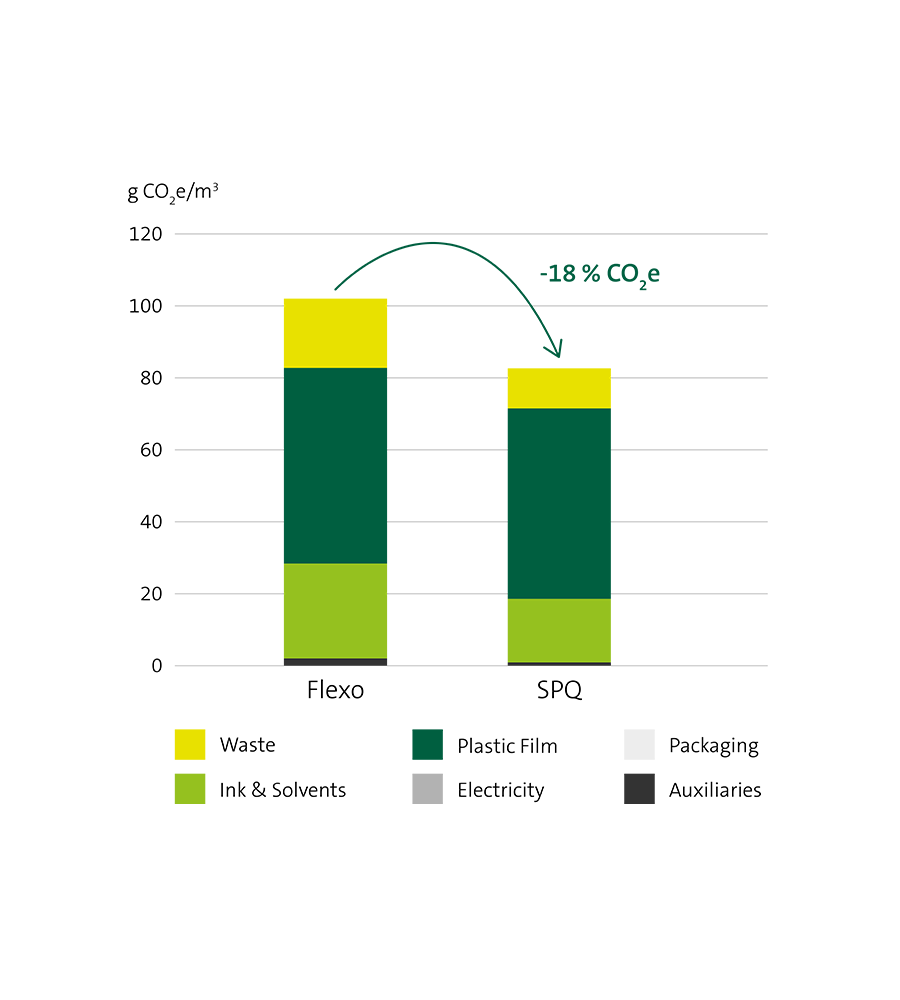
SPQ technology is based on a standardized 7C color space and fixed process parameters. This can reduce the need for spot colors and color changes, as well as the consumption of inks, solvents, and energy. A life cycle assessment verified in accordance with ISO 14040/44 shows that, for the printing scenarios assessed on 20 μm OPP and 12 μm PET, SPQ results in up to 18% lower CO₂e emissions than conventional flexo printing in a cradle-to-gate comparison. The results apply exclusively to the materials, system boundaries, and electricity mixes defined in the study.
Reduced consumption of ink and solvents
Lower expenditure of energy
Less production waste

By using a clearly defined 7C color palette and standardized, consistent color management across the entire process chain, SPQ makes the print process significantly more efficient.
The technology allows for fast design changes, high flexibility, and reliable implementation – even for designs with many variants and small batch sizes. Thanks to high color consistency and color-accurate proofs, print adjustments and print approvals are largely eliminated. The result is shorter setup and approval times, decreased use of materials, and noticeable efficiency gains across the entire process chain.
Greater flexibility
Less film waste
Less effort required for print approvals

The high registration accuracy of SPQ technology supports precise, consistent color reproduction.
Pantone and corporate identity colors are automatically simulated in the 7C color space with color-accurate results. This allows more than 85% of all Pantone colors to be reproduced precisely without the use of spot colors. Consistent color management and contract proofs help maintain stable color consistency across different print runs and production sites.
High register accuracy
Maximum color consistency
Stable, reproducible color conversion
This efficient printing process has also received external recognition: SÜDPACK was selected for the state of Baden-Württemberg’s “100 Companies for Resource Efficiency” initiative. In the relevant case study, a print run of 20,000 m² resulted in CO₂e savings of around 0.25 metric tons compared with standard flexo printing.
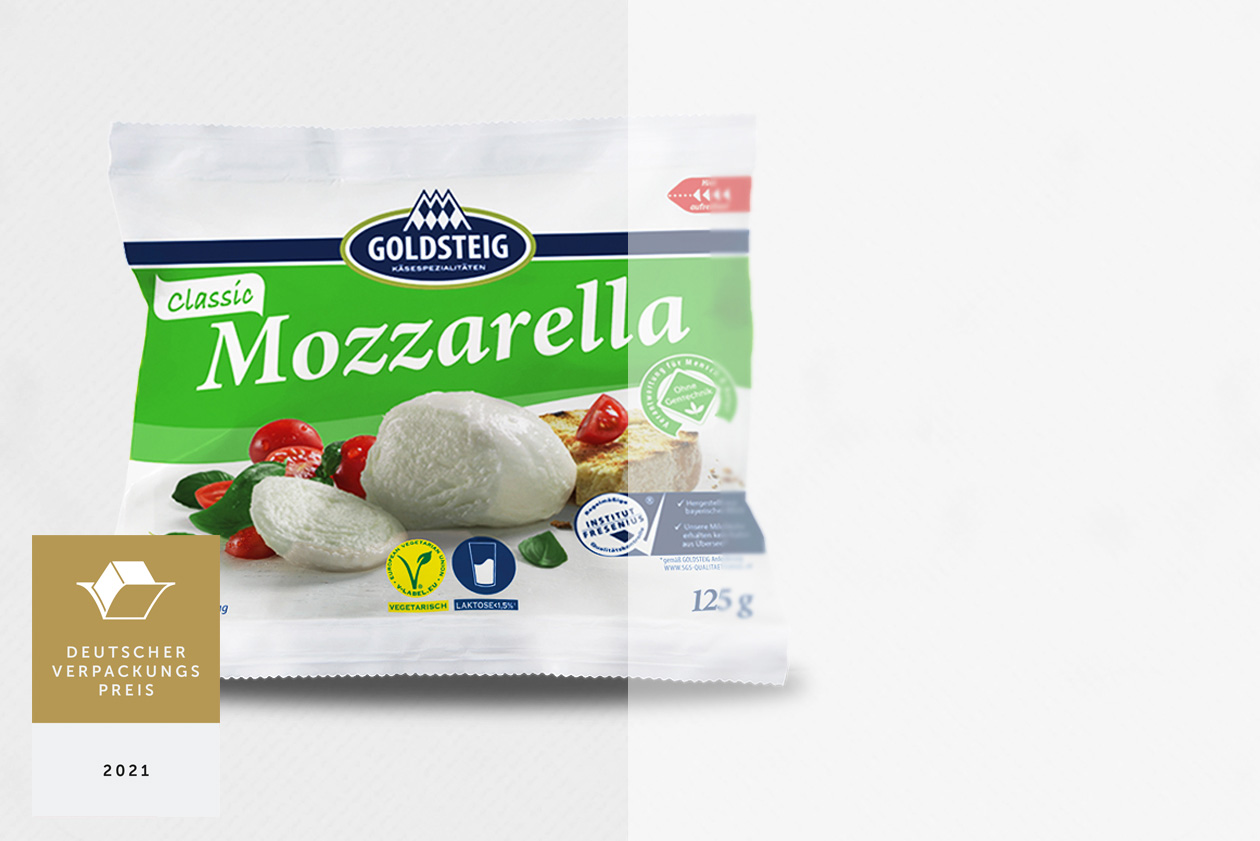
How well SPQ performs in industrial use is demonstrated by the joint project between SÜDPACK and GOLDSTEIG.
High-quality, consistent print quality does not start at the machine – it starts in prepress. That’s why our prepress team plays a central role in SPQ. The team supports brands, packaging teams, and agencies from the outset, ensuring that print data is optimally prepared, color-consistent, and ready for production without unnecessary revision loops.
SPQ flexo printing combines a standardized color process with an extended color gamut. Water-based systems can be used to produce the printing plates, helping to reduce ink and solvent consumption while maintaining high print quality.
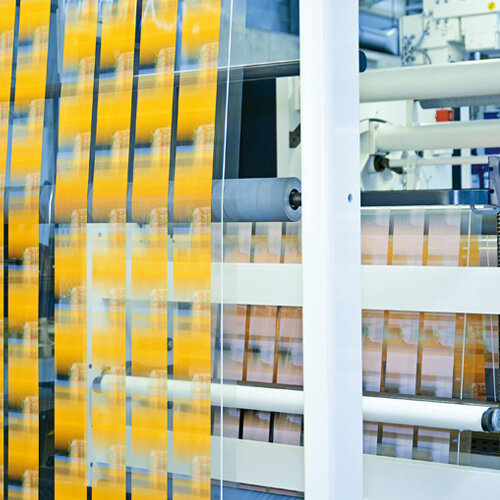
SPQ enables metallic colors to be reproduced in rotogravure printing. Thanks to the polyurethane-based (PUR) ink system, the printed films are suitable for pasteurization and sterilization. This also makes them suitable for temperature-sensitive applications, including packaging for pet food, medical and pharmaceutical products, cosmetics, and personal care products.
Reusable lightweight rotogravure cylinders can be used across multiple production runs, reducing both the need for new cylinders and the associated material consumption.

Expanding CMYK with orange, green, and violet not only expands the color space – it fundamentally changes the process logic. Instead of switching between different Pantone spot colors, SPQ works with a fixed, standardized color set. This reduces variability in color deviations, increases process stability, and enables reproducible results across machines, plants, and countries. At the same time, it lowers resource consumption through fewer color changes, reduced solvent and energy use, and less waste. SPQ is therefore primarily built around efficiency and stability. The expanded color space is simply the visible part of the system.
The industrial use of 7C print requires consistent standardization and control. This includes defined workflows, fixed color parameters, expert color management, modern measurement technology, and clear quality standards across all plants. This level of process discipline is essential to ensuring that SPQ works reliably, efficiently, and sustainably.
Yes. End-to-end color management allows Pantone and corporate identity colors to be simulated precisely in SPQ. Color-accurate proofs with an exact Pantone look serve as the reference for production. The result is high color fidelity, consistent results across all print runs and production sites, and stable brand presentation – even across product variants or relaunches.
Yes. SPQ is suitable for clear, minimalist layouts as well as complex, color-intensive designs where corporate identity colors are critical. The expanded color space enables brilliant results without spot colors, especially with bold accent colors and demanding designs.
This is exactly where SPQ comes into its own. The standardized color palette significantly reduces setup times and makes fast design and variant changes easier. This supports shorter production cycles, smaller batch sizes, and a high level of responsiveness – with consistent quality.
For brands, very little changes in terms of day-to-day operations. Print data continues to be supplied in the usual format, and SÜDPACK handles all processing steps. However, early involvement of SÜDPACK’s prepress experts is recommended for new layouts or relaunch projects. This enables optimal color simulations, reduces the number of revision rounds, and increases planning reliability. On-site print approval is generally no longer required.
In most cases, yes. Almost all existing standard print designs can be transferred to SPQ without restrictions. The standardized 7C workflow is especially beneficial for brands with a wide range of product variants, CI-critical colors, and different print-run sizes.
SPQ is not intended for use in highly specialized flexo print applications, such as surface printing, sterilization applications, or microwave applications that require special ink types (e.g., PU inks). In these cases, an individual assessment is recommended to determine the most suitable print and ink technology.
As a general rule, the earlier SPQ is considered during the development of a new print design, the easier it is to ensure optimal results.
SPQ is fundamentally designed as a standardized 7C system without spot colors. This reduction to a fixed color set is precisely what provides the basis for high process stability, efficiency, and reproducible results across all production sites. At the same time, it is a key lever for reducing resource consumption, emissions, and waste. For special design requirements, such as metallic effects, an adapted SPQ variant may be used in exceptional cases. The decision to use this variant and the specific implementation steps are assessed individually as part of the repro evaluation. These solutions are not part of the SPQ standard and intentionally deviate from the standardized process logic. Because they involve additional colors, greater complexity, and a lower degree of standardization, they generally require more resources and energy, making them less sustainable than the SPQ standard. The aim therefore remains to use SPQ consistently without spot colors, wherever this is technically feasible and strategically appropriate for the brand.
SPQ systematically reduces the use of inks, solvents, energy, and paper waste. The key factor is reduced process variability through fixed color sets and standardized workflows.
A cradle-to-gate LCA verified in accordance with ISO 14040/44 demonstrates CO₂e savings of up to 18% compared with the conventional flexo print process. SPQ therefore makes a measurable contribution to more sustainable package printing.
Switching to a new print process often requires internal change management. SÜDPACK supports customers with transparent process communication, explanatory materials, close coordination with agencies, color management workshops, and color-accurate proofs. This helps ensure a smooth transition without compromising brand impact, product safety, or CI-compliant color reproduction.