SÜDPACK Newsletter
Receive regular updates about SÜDPACK, our products and sustainability topics.
Receive regular updates about SÜDPACK, our products and sustainability topics.
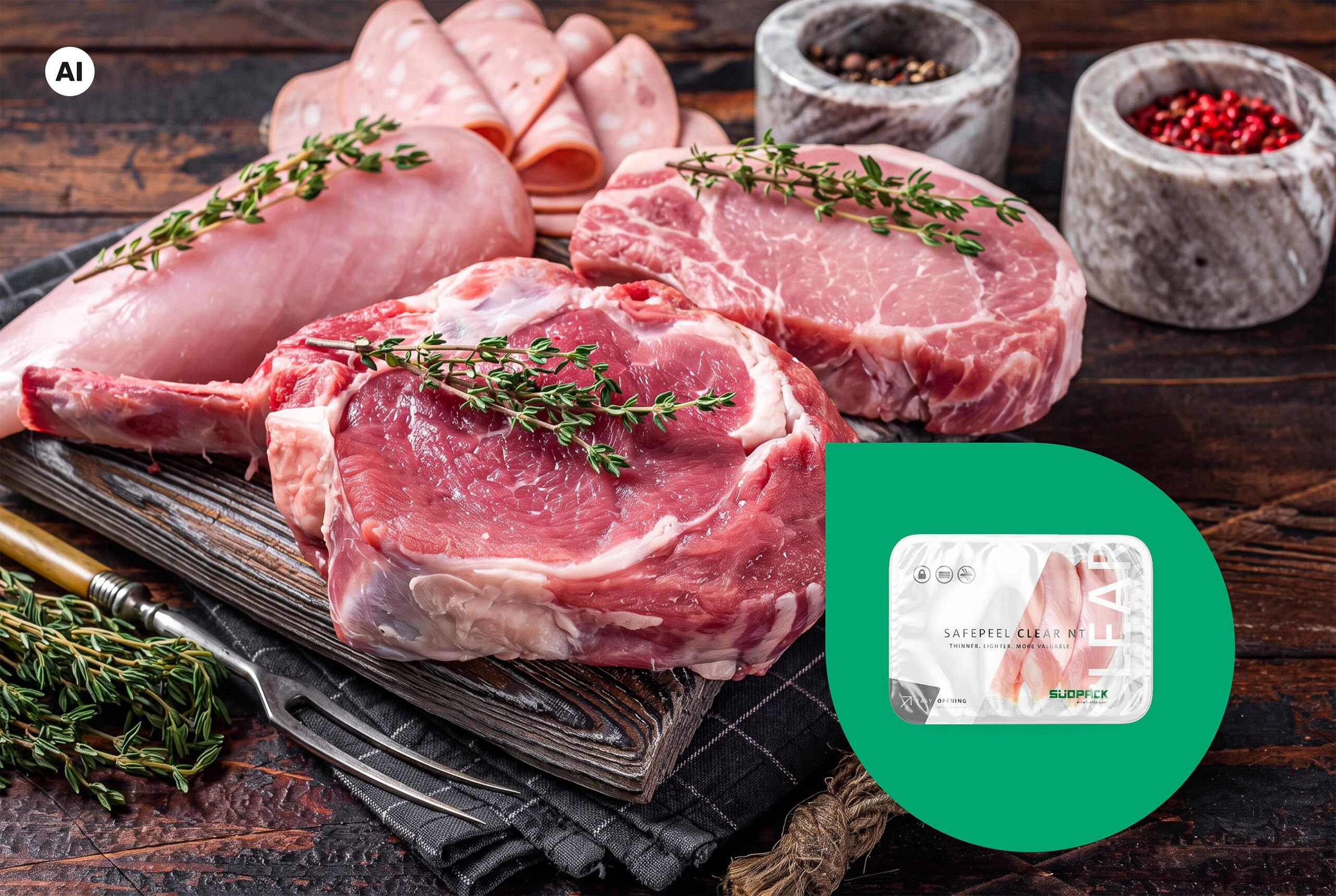
The meat and processed meat industry is facing growing demands, but also new opportunities. In a stakeholder survey, film manufacturer SÜDPACK identified the key trends and expectations shaping Germany’s meat industry. The findings show that companies that can effectively address topics such as shelf life, speed, digitalization, service, and, not least, collaboration between manufacturers, retailers, and suppliers will be well positioned to compete in an increasingly challenging market.
Changing consumer habits, cost and competitive pressures, stringent requirements for product protection and shelf life, and the transition to a circular economy are reshaping Germany’s meat and sausage products industry. This is reflected in a SÜDPACK stakeholder survey of market participants. The findings paint a clear picture: Despite challenging market conditions, companies remain broadly optimistic about the future and are focusing their investments firmly on efficiency, automation, and future-ready packaging solutions.
Sustainability matters to the processed meat industry
One point emerges clearly from the survey: Sustainability matters to the industry. On average, companies rate their own targets – often aligned with initiatives such as the SBTi – very highly, as they do relevant certifications (e.g., EcoVadis). Supplier selection, however, is rated somewhat lower. This is notable, as studies show that in the meat industry, up to 70% of the environmental footprint is generated not at a company’s own facilities, but upstream in the supply chain – in areas such as livestock, packaging, ingredients, and logistics – and therefore falls under Scope 3.
At the same time, the PPWR will have a major impact on material choices, recycled content requirements, and reusability. The greatest potential clearly lies in the use of PP- or PET-based mono-materials and in reducing material thickness – without compromising stability, shelf life, or optics.
The findings show that the industry is ready to make further progress on sustainability. The key, however, is not simply to optimize existing packaging, but to develop entirely new, practical packaging concepts – holistic solutions that are technically viable, economically sound, and supported by retailers.
Major investments, especially in digitalization and automation
The food retail trade is a major driver of product ranges, packaging formats, transparency, and sustainability documentation. As a result, manufacturers increasingly need partners that can provide not only high-performance materials, but also data, technical advice, and a sound basis for decision-making. The industry is therefore stepping up investment in the digitalization and automation of its production operations, as well as in digital connectivity such as EDI, enabling companies to work in an integrated way, maintain the required documentation, and, above all, serve food retailers more efficiently. The emphasis is on modernizing processes that offer the greatest immediate potential to improve efficiency and process stability while reducing costs.
In short, a product alone is no longer enough. Services and support will shape the future – what matters most is the complete package: more information, a stronger factual basis, greater transparency, and more support.
As for market developments ...
... the meat and processed meat industry expects consolidation to continue over the next 24 months. Convenience, reliable availability, and the ability to respond quickly are also becoming increasingly important. Portioned, easy-to-prepare products and convenient snack formats are also in demand. Retailers, meanwhile, are increasingly seeking German meat produced to higher animal welfare standards. Costs, staffing, bureaucracy, regulation, and animal welfare requirements are adding further pressure.
Despite these challenges, the industry remains optimistic about the future. Poultry in particular is seeing growing demand, thanks to its availability and versatility. The downward trend in pork also appears to have leveled off, with both poultry and pork seeing a strong trend toward convenience products. Beef, by contrast, has a relatively small convenience segment, as it is traditionally perceived as a more premium product. For beef, the focus is clearly on shelf life.
In the sausage segment, companies are increasingly specializing in organic products, regional products, budget ranges, or highly automated production to set themselves apart more clearly, while retailers’ own meat processing operations focus on consistent high volumes and efficient processes. According to SÜDPACK’s stakeholder survey, these companies have already clearly recognized the importance of PPWR-compliant packaging and are increasingly switching to packaging designed for recycling.
Overall, the picture is mixed: The future of the market will be shaped not by any particular type of meat, but by price, availability, convenience, and shelf life.
Packaging systems and supplier proximity are key
Two systems continue to dominate packaging concepts: MAP and vacuum packaging. The meat tray remains firmly established as the industry standard. Attempts to switch to flow packs – despite their clear economic and environmental benefits – have met with only limited acceptance. Stand-up pouches, by contrast, are seeing a real surge in popularity, especially for snacks and convenience products, thanks to their practicality, flexibility, and versatility. When it comes to printing technology, the decisive factors are cost, quality, and brand impact.
The majority of companies surveyed consider it essential that their film supplier be based in Germany. Why? Because they value prompt advice, reliable application technology, and a partner that is both dependable and forward-looking.
Broad packaging portfolio for meat and sausages
SÜDPACK offers a wide range of packaging solutions for meat and sausages. The portfolio includes lightweight, PP-based flow packs for ground meat that facilitate recycling; top webs for PP trays that offer high sealing performance, especially when packaging fresh meat; and peelable top webs for APET thermoformed trays, for example for cold cuts. The range also includes flexible PP film concepts for stack packs, as well as PP- or PE-based stand-up pouches for salami sticks and other protein snacks.
SÜDPACK considers the use of PE- and PP-based mono-materials key to advancing the circular economy, since established material loops for both polymers already exist in many EU countries. At the same time, optimizing existing packaging systems remains important. In many cases, reducing film thickness, optimizing pack formats, or incorporating a reclose system can deliver sustainability benefits compared with laminate structures or packaging without a reclose system. The key is to consider material selection and film structure together with sealing performance, mechanical strength, and machinability.
Conclusion: The industry is undergoing profound structural change, but remains optimistic. When it comes to packaging, the future lies in practical, holistic solutions that combine high levels of packaging and process reliability with efficiency, reliable sustainability information, and application-specific advice.