


SÜDPACK Newsletter
Receive regular updates about SÜDPACK, our products and sustainability topics.
Receive regular updates about SÜDPACK, our products and sustainability topics.
How sustainable printing processes are shaping the future of the packaging industry
Sustainable packaging printing is becoming a key lever for resource efficiency and brand impact. With Sustainable Print Quality (SPQ), SÜDPACK shows how modern printing technologies can reduce CO₂ emissions, waste, and energy consumption—without compromising color brilliance or quality. For brands, this creates an opportunity to combine sustainability, efficiency, and consistent brand presence across the entire value chain.
 08/06/2026
  6 min.
 Why the printing process matters environmentally
Regulatory pressure and political framework conditions
Market trends and new requirements
What sustainable printing processes mean: four principles
Technology drivers behind sustainable printing processes
In practice: how modern, sustainable processes reduce CO₂, energy and waste
Sustainable printing as a building block for a circular future
Every product we pick up at the supermarket tells a story—not only about what is inside, but also about the packaging that protects and presents it. Packaging print plays a key role here: it creates brand recognition, strengthens brand identity, communicates information and of course drives shelf appeal at the point of sale.

Alongside environmental considerations, regulatory requirements are also driving the development of sustainable printing technologies:
EU Green Deal
-holistic view of production processes across the value chain
- strong focus on emissions reduction and resource efficiency
Extended Producer Responsibility (EPR)
- Greater responsibility of companies for the environmental impact of their packaging
- growing relevance of printing and converting in sustainability assessments
CO₂ pricing
-rising costs for energy-intensive processes
- sustainable printing is becoming an economic competitive advantage
At the same time, the demands of the packaging market are changing significantly:
- Smaller batch sizes and greater product variety: shorter product life cycles and more frequent design changes
- Growing demand for flexibility: the economic limits of conventional printing processes are becoming more visible
- Consistently high quality expectations: sustainability cannot come at the expense of color brilliance and brand impact
Modern sustainable printing technologies show that these requirements can be combined. Solutions such as Sustainable Print Quality (SPQ) from SÜDPACK illustrate how resource efficiency, process stability, and premium print quality can be brought together in a future-ready sustainable concept.
A stable printing process reduces the number of correction loops, production adjustments and restarts—thereby lowering material and energy consumption.
Standardized color palettes and color management systems make reproducible, consistent color rendering possible—regardless of machine, location or print job.
Fewer ink changes, lower solvent use, durable printing plates and automated processes help to reduce CO₂ emissions and waste.
Sustainability and first-class print quality are not mutually exclusive—quite the opposite. Modern technologies enable especially precise color reproduction and register accuracy.
The packaging industry has seen several major innovation leaps in recent years. Among the most influential:
7C printing / extended gamut printing
A clearly defined set of seven process colors (CMYK + orange, green, and violet) can reproduce the majority of print motifs — without frequent color changes.
Benefit: less waste, less ink and shorter setup times.
Standardized color management
Digital prepress technologies ensure that print data can be implemented consistently, independently of the machine and without lengthy adjustments.
Durable printing plates and cylinders
In rotogravure printing, lightweight, reusable cylinders enable long service lives; in flexographic printing, modern plates (water-based) enable long life cycles.
More environmentally friendly ink systems
New ink and color formulations reduce solvent content—or, in certain segments, eliminate solvents altogether.
Automation and digitalization
Inline measurement systems, AI-based color control and automated setup processes minimize manual intervention—and with it resource consumption and sources of error.
Sustainable printing processes deliver impact above all through the cumulative effect of many small improvements:
→ Significantly less waste thanks to stable processes and fewer color corrections
→ Lower ink consumption because printing uses clearly defined color sets
→ Less solvent use, especially relevant in flexographic and rotogravure printing
→ Energy savings because setup times are reduced
→ Reproducibility that makes test prints and on-site approvals largely unnecessary
At industrial scale these effects can have an enormous impact. Even small process improvements can save significant amounts of CO₂ when print runs reach tens of thousands of square meters.
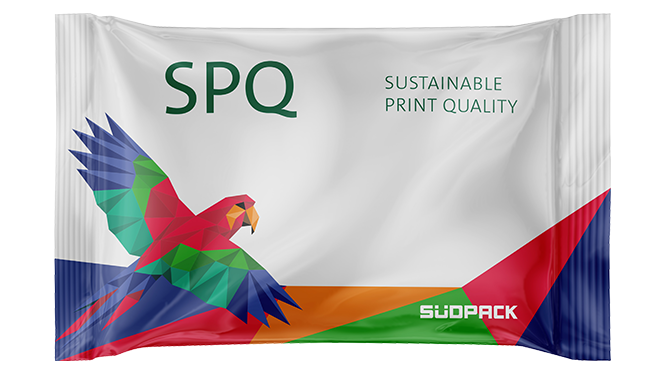
A vivid example of how sustainable packaging print works at industrial scale is the SPQ – Sustainable Print Quality concept developed by SÜDPACK. It shows how quality stability, efficiency, and CO₂ reduction can be linked through consistent standardization.
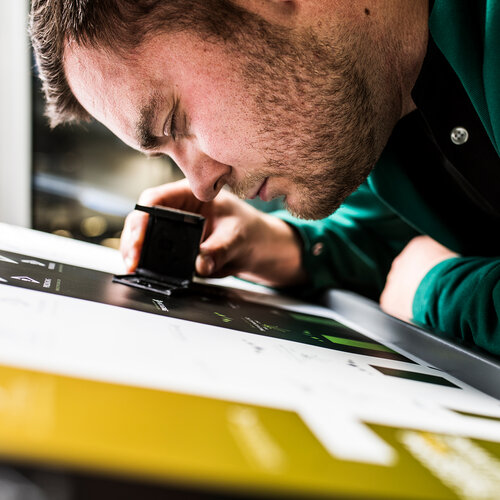
SPQ enables an especially precise and stable print image—a crucial factor for strong brand communication.
→ High register accuracy for sharp, clean print results
→ Stable color reproduction thanks to fully standardized color management
→ Maximum color consistency across plants, machines and print runs
→ Fewer corrections and hardly any on-site approvals, because proof and print are nearly identical
The fixed color palette reduces complexity and makes the process much more flexible.
→ Fewer color changes → faster setup and less downtime
→ High flexibility for variants and design changes
→ Less coordination effort, because colors are predictable and stable
→ Lower material consumption, especially during startup and repeat jobs

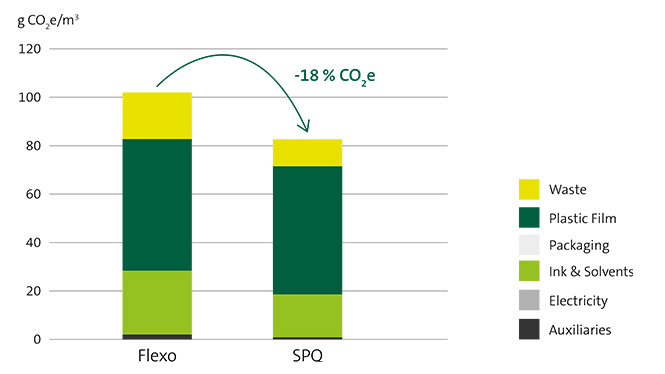
The environmental impact is measurable—and it results from the sum of many process improvements.
→ Less ink and fewer solvents, as special inks are no longer required
→ Lower energy use through shorter setup processes
→ Significantly less waste and production waste (For example, around 0.25 metric tons of CO₂ savings for 20,000 m² of print area)
This example shows how modern printing technologies can combine efficiency, brand quality, and sustainability.
Sustainable packaging print unlocks its full potential especially when it is part of a holistic packaging concept:
recyclable films, reduced material use, optimized production processes and efficient logistics.
Technologies such as SPQ help companies reduce their environmental footprint across the entire value chain—while also strengthening brand impact at the point of sale.
In the years ahead, the industry will be shaped by:
→ digitized prepress workflows
→ AI-supported color control systems
→ resource-saving ink systems
→ automated setup processes
→ closer integration of printing technology and recyclable materials
SPQ from SÜDPACK is therefore becoming more than a quality feature—it is becoming a key competitive factor for brands that want to act responsibly while offering high-quality products.
Sustainable printing processes are no longer a niche topic. They form the foundation for a responsible, efficient and future-ready packaging industry. Technologies such as SPQ show that premium print quality and significant CO₂ reduction are not a contradiction—they are the future.