


SÜDPACK Newsletter
Receive regular updates about SÜDPACK, our products and sustainability topics.
Receive regular updates about SÜDPACK, our products and sustainability topics.
Food waste is one of the biggest global challenges of our time – and packaging can be a key part of the solution.
In theory, there is enough food to feed everyone. And yet millions of people around the world still go hungry, while enormous quantities of food are lost or thrown away. This tension makes food waste one of the most pressing sustainability issues of our time. To solve the problem, we need to understand where losses occur along the value chain – and why even small measures can make a big difference.
 14/07/2026
  3 min.
The figures are impressive: more than eight billion people now live on planet Earth, and that number continues to rise. At the same time, the number of people suffering from malnutrition and undernourishment – and dying as a result – is also increasing. According to estimates by the FAO (Food and Agriculture Organization of the United Nations), up to 720 million people are affected by hunger each year, with 94% living in Africa and Asia. Around 9 million people die every year as a result of food deprivation.
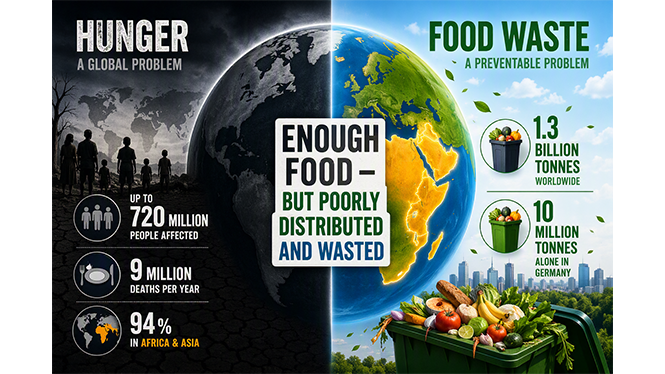
These alarming figures raise an obvious question: why? Because, at least in theory, there would actually be enough food for everyone. But the reality is this: all over the world, food is lost somewhere along the process chain. In Germany alone, at least 10 million tons of food still end up in the trash every year. Globally, the volume of discarded or lost food is estimated at 1.3 billion tons. If we delve even deeper into the figures, we see that the numbers become even more striking: for fresh fruit and vegetables, losses can account for around half of total production.
The pressure to act is growing. According to the United Nations, the global population is expected to reach around 10 billion by 2050. At the same time, urbanization is increasing rapidly: already, more than half of the world’s population lives in cities. According to the FAO and the UN, food production would need to increase by roughly 60 to 70% compared to current levels to keep pace with projected population growth. In the context of overall resource scarcity, this assessment carries even more weight. Every time food is wasted, the resources used to produce it are wasted as well. One thing is clear: if we want to provide more people with safe, hygienic food in the future, we need to use existing resources far more efficiently than we do today.
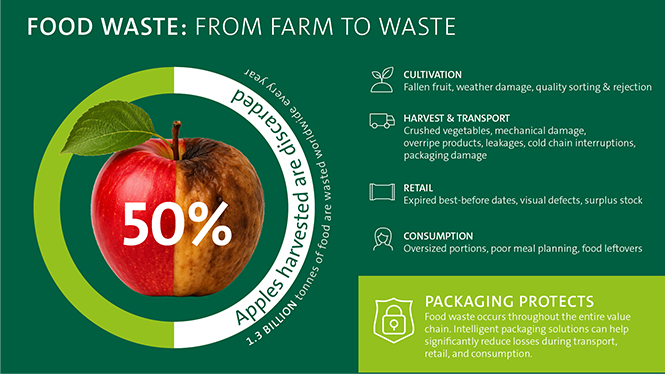
In developing regions, food losses often occur at the very beginning of the value chain.
The reasons include inadequate infrastructure, limited cooling and storage capacity, insufficient packaging and marketing concepts, and a lack of technical equipment.
The result: food spoils before it ever reaches the consumer.
In industrialized and emerging economies, waste tends to occur later – at the retail stage, in food service, and in private households.
Products are thrown away because they do not look the way they should, the best-before date is misinterpreted, excessive quantities have been purchased or opened products are no longer sufficiently protected.
The causes therefore vary significantly – which is exactly why solutions also need to be tailored regionally and across the chain.
The issue is also gaining momentum politically. Especially in recent years, numerous initiatives and regulatory measures have been launched, and they are steadily gaining traction.
With its 2030 Agenda and especially UN Sustainable Development Goal 12.3, the United Nations has set important targets to significantly reduce global food waste and food loss along production and supply chains – including post-harvest losses – by 2030.
In the EU, binding reduction targets now apply through 2030: 10% less food waste in processing and manufacturing, and 30% less per capita in retail, food service, and households.
In Germany, the “Pact Against Food Waste”, signed by 14 major wholesale and retail companies, is creating additional momentum.
The pact aims to reduce food waste by 30% by 2025 and by 50% by 2030.
Note: Selected graphics used in this article were created with the support of generative AI.