


SÜDPACK Newsletter
Receive regular updates about SÜDPACK, our products and sustainability topics.
Receive regular updates about SÜDPACK, our products and sustainability topics.
Five key levers for improving the greenhouse gas footprint of packaging
Companies seeking to reduce their products’ CO₂e footprint should take a close look at packaging. Material selection, recyclability, the use of recycled content, and product protection can all have a significant impact on the greenhouse gas footprint. Discover which five levers are often especially relevant and how robust data can be used to assess trade-offs between greenhouse gas performance, functionality, and regulatory requirements.
Companies seeking to reduce their products’ CO₂e footprint cannot overlook packaging. With CSRD reporting obligations, PPWR packaging requirements, and the climate targets set by many companies, reducing packaging-related CO₂e emissions is receiving increasing attention. A packaging Product Carbon Footprint (PCF) indicates the greenhouse gas emissions attributed to a package within the defined system boundaries.
But which measures can deliver relevant savings in a specific application? And why does a decision driven by an environmental objective not automatically produce the most favorable greenhouse gas footprint? The answer lies in taking a holistic view of a package’s life cycle. This is precisely where life cycle assessments (LCAs) and product carbon footprints (PCFs) provide the necessary transparency. They create a sound basis for comparing functionally equivalent packaging solutions within clearly defined system boundaries.
A package’s CO₂e footprint includes all greenhouse gas emissions generated throughout its life cycle. These include:
The use phase is deliberately excluded from many packaging PCFs because packaging usually causes only minor direct environmental impacts during this stage.
The factors influencing the greenhouse gas footprint vary depending on the packaging system and the defined system boundaries. In the SÜDPACK LCA scenarios examined, a substantial share of CO₂e emissions is attributable to the input materials used and their production. In these scenarios, input materials therefore represent one of the most relevant starting points for improvement.
When it comes to reducing packaging-related CO₂e emissions, material efficiency is rarely optional.
Every gram of material saved can affect several life-cycle stages: it reduces demand for raw materials and can lower the greenhouse gas emissions associated with the package. For this reason, lightweighting and downgauging are among the most effective CO₂e reduction measures in many packaging applications.
Typical examples include:
SÜDPACK solutions such as CarbonLite® Flow Pack PurePP can reduce material use compared with a specifically defined reference package while still meeting the product protection and processing requirements established for the application.
The actual impact must be assessed based on the relevant packaging specification and basis of comparison.
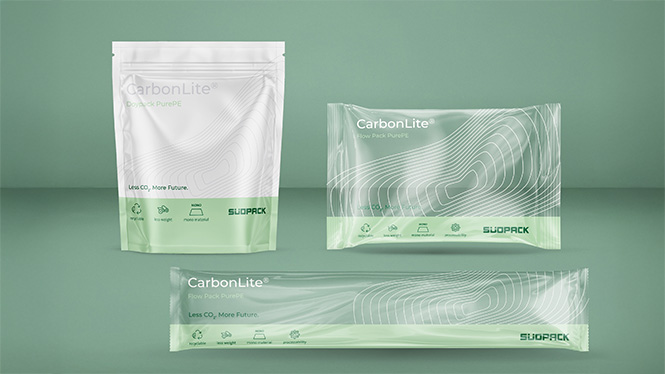
Key takeaway: Using less material can reduce a package’s greenhouse gas emissions. The magnitude of the effect depends on the specific application, material type, functionality, and life-cycle stages considered.
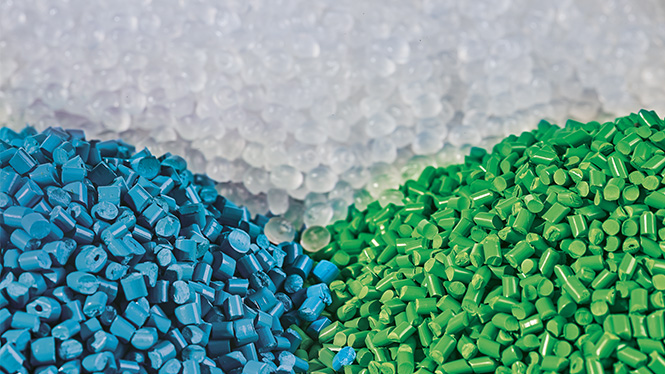
The choice of packaging material has a significant impact on a package’s greenhouse gas footprint.
The question is not simply “paper or plastic?” but rather how the material performs across its entire life cycle. Switching materials can make sense, but the decision must always be evaluated using robust PCF data.
Key factors include the type of material—such as plastic, paper, glass, or aluminum—as well as:
Whether reducing weight is more effective than switching materials entirely cannot be answered in general terms. Decisions about the CO₂e footprint should therefore be based on sound PCF calculations. These make the greenhouse gas emissions of different material options transparent and comparable.
A package’s environmental impact does not end when it is placed in the recycling bin.
With the requirements of the PPWR, recyclability and circularity are becoming increasingly important. The goal is to keep materials in circulation for as long as possible.
This includes:
→ Monomaterial structures
→ Recycling-compatible printing concepts
→ Reduced material complexity
→ Improved sortability
However, it is important to note that recyclability alone does not guarantee an optimal CO₂e footprint.
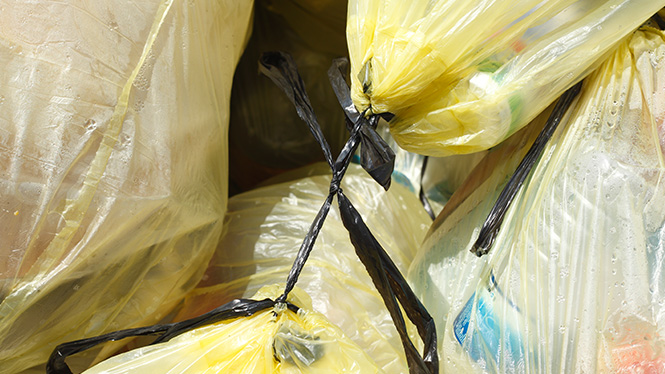
Recyclable packaging can realize its full potential only when suitable recycling streams are actually available and the materials are kept in circulation.
This is why the use of recycled content is becoming increasingly important. Post-consumer recyclates (PCR) in particular can reduce demand for virgin raw materials and thereby help improve the greenhouse gas footprint.
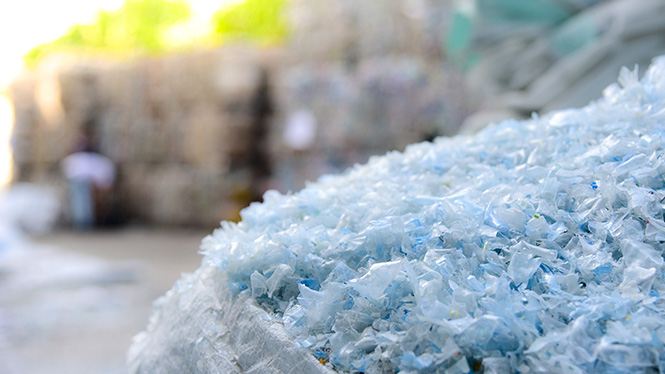
Relevant approaches include:
SÜDPACK identifies the circular economy, regranulation, and recycling technologies as key components of its circular economy strategy. The company’s internal LCA data also shows that mechanical recycling has a lower environmental impact than chemical recycling and thermal recovery in the scenarios examined. This assessment applies to the specific material streams, functional units, and system boundaries analyzed.
Production processes also play a role in the CO₂e footprint. Their share depends on factors such as the process used, the energy mix, equipment efficiency, and the system boundary considered.
The most important measures include:
→ Energy efficiency
→ Use of renewable energy
→ Process optimization
→ Reducing scrap and production waste
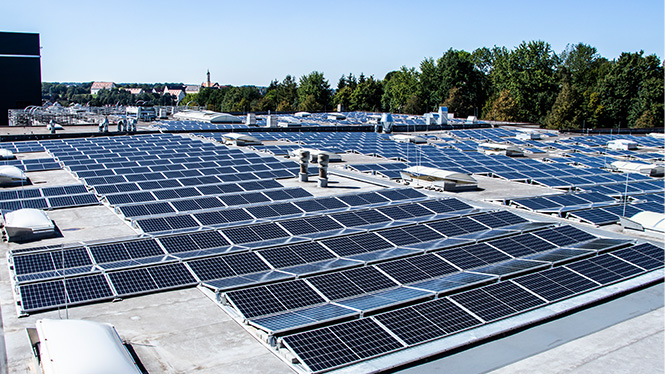
SÜDPACK uses renewable electricity at all of its EU production sites and has reduced energy consumption through efficiency measures compared with the 2021 baseline.
One aspect is often underestimated in discussions about the greenhouse gas footprint of packaging: product protection.
Packaging helps preserve the freshness, quality, and shelf life of food, ensures that important product information is available to consumers, and helps prevent product loss. In medical and pharmaceutical applications, it protects sensitive active ingredients, supports compliance with hygiene and sterility requirements, enables safe dosing, and provides child-resistant yet senior-friendly packaging solutions (CRSF).
A package with a higher CO₂e footprint may still deliver an advantage at the system level if it has been demonstrated for the specific application that the package reduces food loss, for example, or extends shelf life under defined conditions.
Avoiding food loss can reduce greenhouse gas emissions generated during the agricultural production, processing, and distribution of food. Packaging developers must therefore consider not only the packaging itself, but the entire packaging-product system.
The key principle is:
The best packaging solution is not necessarily the one that uses the least material. What matters is striking the right balance between product protection, resource efficiency, and circularity. Design-for-recycling approaches should be aligned with product protection requirements.
Packaging development with environmental objectives often requires balancing trade-offs:
→ More barrier performance or less material?
→ A higher PCR share or maximum product performance?
→ Recyclability or product protection?
→ Material efficiency or machine performance?
This is precisely why there is no one-size-fits-all solution. Every application requires an individual assessment of functional requirements and environmental impacts.

The challenge is not to optimize individual environmental objectives in isolation, but to assess how they interact. Packaging must protect products, meet regulatory requirements, run efficiently in processing operations, and at the same time fulfill the circularity requirements relevant to the specific application.
There is no single lever for achieving a better CO₂e footprint.
Depending on the application, relevant potential may result from combining the following approaches:
Companies seeking to successfully reduce packaging-related CO₂e emissions should therefore avoid relying on isolated measures. A holistic assessment of the entire life cycle based on robust LCA and PCF data is essential.
Only then can sound decisions be made that address greenhouse gas reductions, product safety, economic viability, and regulatory requirements in equal measure.
Relevant potential may lie in reducing material use, selecting appropriate materials, designing for recycling, using recycled content, and implementing energy-efficient production processes. Which measure has the greatest impact depends on the specific application, basis of comparison, and defined system boundaries and should be assessed using LCA or PCF data.
No. Recyclability creates better conditions for a circular economy, but it does not automatically result in the best greenhouse gas footprint. What matters is an assessment of the entire life cycle, including material use, product protection, and suitable recycling routes that are actually available.
Recycled content can reduce demand for virgin raw materials and thereby help improve the greenhouse gas footprint. However, the actual impact depends on the material type, recyclate quality, application, and the recycling processes used.
Product protection can have a significant impact on the greenhouse gas footprint at the system level. If it has been demonstrated for a specific application that packaging reduces food loss or transportation damage, or extends shelf life under defined conditions, it can help reduce greenhouse gas emissions along the value chain. The assessment should therefore consider the entire packaging-product system.