
SÜDPACK Newsletter
Receive regular updates about SÜDPACK, our products and sustainability topics.
Receive regular updates about SÜDPACK, our products and sustainability topics.
Up to 60% less material, high process reliability, and recyclability of more than 90%: what modern minced meat packaging needs to deliver—and when a flow pack can be a smart alternative to a tray.
Flow pack concepts are currently among the most widely discussed developments in fresh meat packaging—and for good reason. The PPWR, growing demands for material efficiency and recyclability, and the increasing link between packaging design and regulatory costs are making packaging a strategic business priority. Under what conditions does switching from a tray to a flow pack make sense for minced meat? Holger Hoss, Head of Strategic Product Management at SÜDPACK, shares his perspective.
Mr. Hoss, why are so many meat producers currently exploring flow pack solutions for minced meat?
Can a flow pack meet the demanding requirements of minced meat?
What specific packaging requirements does minced meat have?
Let’s start with product protection. Can a flow pack deliver the same shelf life as a tray?
Many producers see sealing—not barrier performance—as the biggest challenge. Are they right?
How important are design for recycling and material efficiency to the economics of packaging?
What does this mean in practical terms for a producer considering a switch?
What role does presentation at the point of sale play?
Does the trend toward flow packs mean the long-term end of tray packaging?
What is your most important recommendation for producers considering a switch?
Holger Hoss:
“The key driver is the combination of cost-effectiveness, sustainability, and regulatory requirements. Producers are looking for ways to reduce packaging material and costs while preparing their packaging portfolios for the future.
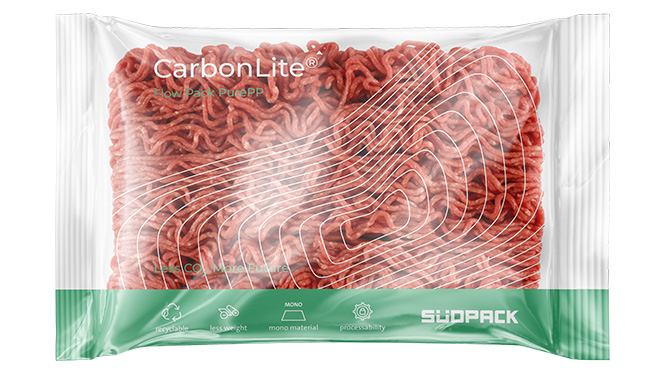
Flow pack concepts offer considerable potential. Compared with a comparable tray solution, CarbonLite® Flow Pack PurePP can reduce material use by up to 60%. Across 10 million packages, that equates to around 75 metric tons less packaging material.
At the same time, it can provide benefits in storage, transportation, and logistics. In addition, design for recycling and recyclability will no longer be viewed solely as sustainability metrics; they are becoming increasingly relevant from an economic perspective. Packaging is being evaluated more and more on its circularity.
That is why many producers are currently assessing whether modern flow pack solutions can replace or complement their existing tray concepts.”
Holger Hoss:
"Yes. Today’s flow pack concepts can meet the same high standards for product protection, shelf life, and process reliability that producers expect from conventional tray solutions.
In practice, every packaging decision starts with the product. Minced meat is one of the most demanding fresh food applications. The packaging solution must therefore meet four key requirements: product protection and shelf life, process and package reliability, presentation at the point of sale, and sustainability."
Holger Hoss:
"For product protection and shelf life, a high-performance oxygen barrier and modified atmosphere packaging (MAP) are essential. Only if the protective atmosphere is reliably maintained can oxidation be prevented and the required shelf life achieved.
When it comes to process and package reliability, the priorities are secure sealing, high line speeds, and dependable machinability. Product juices, potential contamination in the sealing area, and high machine speeds make minced meat one of the most demanding fresh food applications.
Presentation at the point of sale is equally important. Consumers expect an unobstructed view of the product and a consistently fresh appearance.
Finally, sustainability requirements continue to gain importance. The market is looking for recyclable packaging, reduced material use, and a lower carbon footprint."
Holger Hoss:
"Yes. What matters is not the packaging format itself, but the performance of the entire packaging system.
For minced meat, a high oxygen barrier, reliable sealing performance, and a stable protective atmosphere are essential. CarbonLite® Flow Pack PurePP was developed specifically to meet these requirements.
The high-barrier version achieves an oxygen transmission rate of less than 2.5 cm³/m²/day. Combined with MAP, it creates a packaging solution that reliably supports the shelf life of sensitive meat products throughout the value chain.
MAP also serves a dual purpose: it helps preserve shelf life while creating a variable protective cushion. This reduces mechanical stress during transportation, handling, and product display.
Equally important for consumers, the transparent anti-fog film provides a consistently clear view of the product’s freshness and quality in the refrigerated display case."
Holger Hoss:
"Absolutely. The seal is one of the most critical factors in minced meat applications. Product liquid, potential contamination in the sealing area, and high production speeds place exceptional demands on both the packaging and the machine.
If sealing is not consistently reliable, leaks can occur. This has a direct impact on shelf life, product protection, and reject rates.
That is why we designed CarbonLite® Flow Pack PurePP for high seal strength and a wide sealing window. Combined with optimized slip properties, the solution enables stable processing on horizontal form-fill-seal lines, even at speeds of more than 100 packages per minute.
The result is high process reliability, consistent package quality, and reduced downtime."
Holger Hoss:
"Far more important than they were just a few years ago.
Under the PPWR and extended producer responsibility systems, packaging will increasingly be evaluated not only by material cost but also by its circularity. Design for recycling is therefore evolving from a sustainability topic into a factor in economic competitiveness.
For producers, this means material efficiency, recyclability, and regulatory requirements must be considered together.
CarbonLite® Flow Pack PurePP combines precisely these elements. The mono-material solution achieves recyclability of more than 90% and reduces material use by up to 60% compared with a comparable tray solution. Across 10 million packages, that equates to around 75 metric tons less packaging material.
However, the economic impact extends far beyond material savings alone. Using less material often also means lower storage and logistics requirements, reduced transportation costs, and potential benefits related to packaging fees and future regulatory requirements.
A packaging conversion should therefore not be evaluated on material price alone. What matters is the business case for the entire packaging system across the value chain."
Holger Hoss:
"They should compare different scenarios systematically.
How much material is being used today? What are the implications for packaging costs, storage requirements, and transportation? What savings can be achieved across the supply chain? Which regulatory costs can be positively influenced by packaging designed for recycling? And what investments in packaging equipment are required?
Only this comprehensive assessment can produce a robust business case.
That is why a packaging conversion is always a system-level decision, not simply a material choice."
Holger Hoss:
"A very important one. Packaging must not only perform reliably; it must also present the product attractively.
CarbonLite® Flow Pack PurePP combines high transparency with anti-fog properties. This keeps the product clearly visible at all times, making freshness and quality immediately apparent.
At the same time, the film offers excellent opportunities for premium print quality and impactful brand communication. Modern flow pack concepts now enable high-quality, contemporary presentation in the refrigerated display case."
Holger Hoss:
"No. Products, production processes, and go-to-market strategies vary too widely.
Both tray and flow pack solutions have their place. The key question is not which format is fundamentally better, but which packaging concept meets a product’s requirements most efficiently.
The interesting shift is that packaging is increasingly viewed as a strategic success factor. Material efficiency, recyclability, logistics, regulatory requirements, and carbon reduction are becoming more important, bringing packaging decisions more sharply into management focus.
Flow packs offer minced meat producers significant potential for material savings, recyclability, and logistics optimization. However, the success of a packaging conversion depends less on the material itself than on how well the packaging concept is tailored to the product’s specific requirements.
There is no one-size-fits-all solution. The right approach is:
Define product requirements → select the packaging concept → choose the material."
Holger Hoss:
"I would always start with the product and the company’s specific objectives.
First, the requirements for product protection, shelf life, line performance, and marketing must be defined. The next step is to determine which packaging concept best meets those requirements from a technical, economic, and sustainability perspective. Only then should the material be selected.
It is important not to view packaging as a material choice alone. It affects cost structures, process efficiency, recyclability, regulatory compliance, logistics, and ultimately a company’s competitiveness.
A sound assessment should therefore include product and machine trials as well as an analysis of material use, recyclability, carbon footprint, investment requirements, and overall economic viability.
The answer does not necessarily have to be a flow pack. What matters is finding the packaging concept that best combines product protection, process reliability, cost-effectiveness, and sustainability.
That is precisely how we see our role at SÜDPACK: we evaluate not individual materials, but the entire packaging system. Together with our customers, we assess technical feasibility, economic viability, and sustainability to identify the best long-term solution for each application."