

SÜDPACK Newsletter
Receive regular updates about SÜDPACK, our products and sustainability topics.
Receive regular updates about SÜDPACK, our products and sustainability topics.
Between greenwashing and credibility: why companies should act now
Sustainability communication is facing new challenges: With the EmpCo Directive, the EU will tighten the requirements for environmental and sustainability claims starting in September 2026. For companies, this means reducing the risk of greenwashing and focusing on precise, evidence-based, and transparent information.

What is the EmpCo Directive?
What will be considered an environmental claim in the future?
New rules for sustainability communication: What will be prohibited?
1. Generic environmental claims without evidence
2. Overgeneralizing environmental benefits
3. Climate neutrality through compensation
4. Company-owned sustainability seals
5. Environmental targets only with a robust implementation plan
B2C and B2B: Are there differences?
What does this mean for the packaging industry?
Checklist: How to avoid greenwashing
Conclusion: Precision is becoming the new standard
FAQ: EmpCo Directive and sustainability communication
Sustainability has long since become an key competitive factor with customers, business partners, and investors expecting transparent information on environmental performance, recyclability, CO₂ emissions, and the use of recycled content. At the same time, environmental claims are subject to growing regulatory scrutiny especially those that are insufficiently substantiated or overly broad.
The European Union is significantly tightening the requirements for sustainability communication through the Empowering Consumers Directive (EmpCo Directive). The Directive (EU) 2024/825 has been implemented in Germany through amendments to the Act Against Unfair Competition (UWG) and will apply from September 27, 2026. The directive aims to combat greenwashing, improve consumer protection and promote fair competition by ensuring that environmental information is transparent and verifiable.
For companies, this means that the scope for environmental and sustainability claims will become much narrower. In the future, the focus will be on claims that are specific, evidence-based, and objectively verifiable.

The EmpCo Directive (Empowering Consumers Directive) supplements existing European consumer protection rules and targets misleading environmental and sustainability claims. In particular, it tightens the rules for environmental advertising, sustainability labels, and green claims.
Important to note: The EmpCo Directive is not the same as the Green Claims Directive. While the Green Claims Directive is intended to create specific requirements for substantiating and verifying environmental claims, the EmpCo Directive already defines which claims are allowed and which practices are considered unfair.
The new rules for sustainability communication affect nearly all public communication channels, including:
→ Corporate websites
→ Social Media communication
→ Online magazines
→ Advertisements
→ Brochures and product information
→ Press releases
→ Marketing materials
→ Excerpts from sustainability reports, if used for promotional purposes
The term environmental claim is deliberately defined very broadly.
It includes all voluntary statements, images, symbols, labels, or representations that create the impression that:
- a company acts in a particularly environmentally friendly way
- a product causes a lower environmental impact
- environmental performance has improved
- a positive environmental impact is achieved
This means that not only text, but also symbols, seals, or the combination of imagery and wording can be relevant.
One of the most important changes concerns generic environmental claims.
Terms such as “environmentally friendly”, “green”, “sustainable”, “climate-friendly”, “ecological”, “CO₂-friendly”, “energy-efficient”, “biodegradable”
may no longer be used in a blanket way unless they are based on recognized excellent environmental performance or are directly specified, as in this example:
“The packaging is 95% recyclable according to test method XY.”
The key difference: The claim describes exactly which environmental aspect is relevant and how the performance was measured.
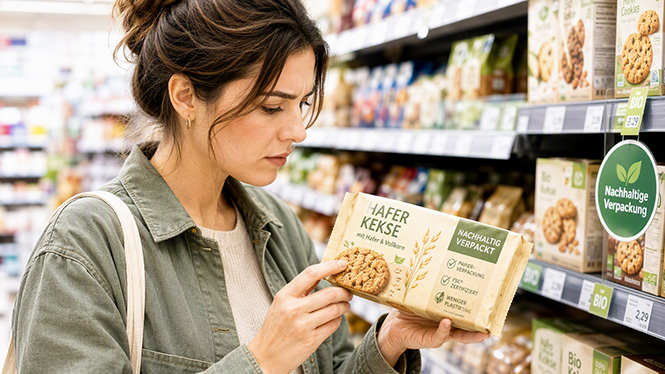
In the future, a claim must not appear broader than the actual environmental performance. Companies must also clearly indicate exactly what a claim refers to.
The ban on climate-impact claims based exclusively on compensation measures is particularly relevant.
Terms such as:
- “climate-neutral”
- “CO₂-neutral”
- “positive environmental impact”
may not be used if the claimed effect is achieved solely through offsetting or the purchase of certificates.
This will increase the risk of greenwashing allegations, especially in marketing.
Sustainability labels are also coming under greater scrutiny.
Company-owned, non-certified sustainability seals will be viewed more critically in the future. Permissible labels will primarily include government-established labels or certification systems with transparent criteria and independent verification.
Claims about future environmental performance will also be regulated more strictly.
The Directive requires concrete, realistic, and verifiable implementation plans. One example would be:
“Our goal is to reduce CO₂ emissions by 50% by 2040, based on a published action plan with defined interim targets and regular independent review.”
Formally, the EmpCo Directive primarily addresses consumer communication. Nevertheless, industrial companies should apply the same standard in the B2B sector as well.
The reason: Public communication — for example on websites, at trade fairs, in brochures, or on social media — can be reviewed under competition law regardless of the target audience. In addition, business partners increasingly expect the same level of transparency as consumers.
For food manufacturers, brand owners, and packaging companies, this means in practice:
The same claim should withstand critical review in both B2B and B2C contexts.
Sustainability arguments are used frequently in the packaging sector,which is why the requirements for evidence and documentation are increasing.
Permissible and valuable claims may include, for example:
- Recyclability / Design for Recycling
- PCR content / recycled-content share
- Product Carbon Footprint (PCF)
- Weight reduction
- Share of bio-based raw materials / use of non-fossil raw materials
What matters is that these claims are always traceable and substantiated.
Practical tip:
Anyone referring to a “25% CO₂ reduction” should always document:
- Which reference product was used for comparison
- Which system boundaries apply
- Which unit was used
- Which calculation method was applied
For example, a comparison of kg CO₂e per kilogram of material cannot be directly compared with kg CO₂e per square meter of film.
Companies should systematically review their existing communication before September 2026.
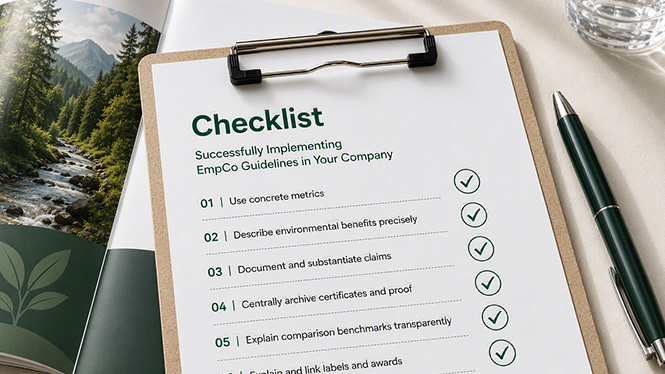
Do's
✅ Use specific metrics
✅ Describe environmental benefits precisely
✅ Document and substantiate claims
✅ Centrally archive certificates and supporting evidence
✅ Explain comparison bases transparently
✅ Explain and link labels and awards
Don'ts
❌ Make broad sustainability promises
❌ Use vague terms such as “green” or “environmentally friendly”
❌ Make claims without a sound data basis
❌ Use climate-neutrality claims based solely on compensation
❌ Transfer individual product benefits to the entire company
❌ Advertise with legal minimum requirements
The EmpCo Directive marks a turning point for the rules governing sustainability communication. In the future, it will no longer be enough for claims simply to be “not misleading.” Companies must be able to prove exactly what an environmental benefit refers to, how it was measured, and what evidence supports it.
For companies in the food, pharmaceutical, and packaging industries, this means one thing above all: moving away from broad sustainability promises and toward specific, transparent, and reliable information.
Companies that adapt their processes, documentation, and communication to the new requirements early on cannot only reduce legal risks, but also strengthen credibility with customers, business partners, and other stakeholders.
The EmpCo Directive (Empowering Consumers Directive) is the EU Directive 2024/825. It tightens the rules against greenwashing and strengthens the requirements for environmental and sustainability claims. [eur-lex.europa.eu], [umweltbundesamt.de]
The new rules will apply from September 27, 2026. [commission.europa.eu], [umweltbundesamt.de]
Claims must be precise, traceable, and substantiated. Generic environmental promises without sufficient specification will become problematic or impermissible in the future.
Although the rules primarily aim to protect consumers, public B2B communication should follow the same standards, since competition-law risks can also arise here.
Violations may lead to consequences under competition law, such as objections, cease-and-desist claims, or further legal action. The requirements for verifiability and transparency are increasing significantly. [umweltbundesamt.de]
Note: This article is based on our own research and is intended for general information purposes only. It does not constitute legally binding advice. If specific claims or communication measures need to be reviewed, legal advice should be obtained where necessary.
Note: Selected graphics used in this article were created with the support of generative AI.