



SÜDPACK Newsletter
Receive regular updates about SÜDPACK, our products and sustainability topics.
Receive regular updates about SÜDPACK, our products and sustainability topics.
Why there is no such thing as perfect packaging
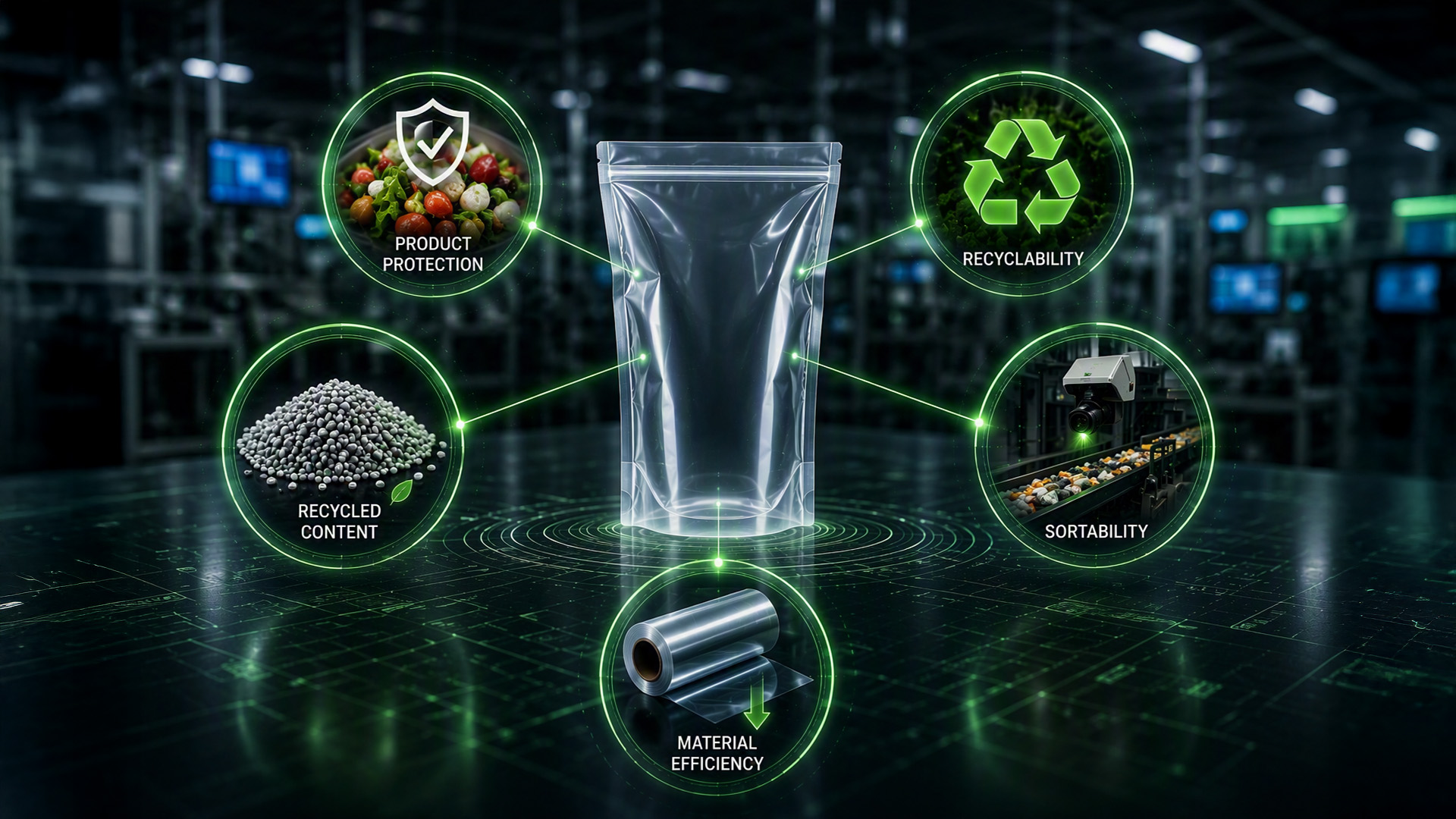
Sustainable packaging must go beyond recyclability. It has to protect products, use materials efficiently, incorporate recycled content where appropriate, and remain compatible with sorting and recycling systems. This article looks at the key challenges shaping sustainable packaging development — and at approaches that can help bring functionality and circularity into balance
Challenge 1: Barrier performance versus recyclability
Challenge 2: Color and design versus sortability
Challenge 3: Functional additives versus recyclate quality
Challenge 4: Recycled content versus consistent performance
Possible solutions: Addressing conflicting goals intelligently
The demands placed on modern packaging continue to grow. Packaging has to protect products safely, run efficiently on packaging lines, conserve resources, meet regulatory requirements, and support a functioning circular economy. This is exactly where the greatest challenges in sustainable packaging development begin.
Every material decision has consequences. An improvement in one area can create limitations in another. Packaging developers therefore face the ongoing task of weighing different requirements against one another and identifying solutions that deliver the strongest overall benefit.
The real challenge is not meeting individual sustainability goals in isolation. What matters most is aligning product protection, functionality, cost-effectiveness, and recyclability.
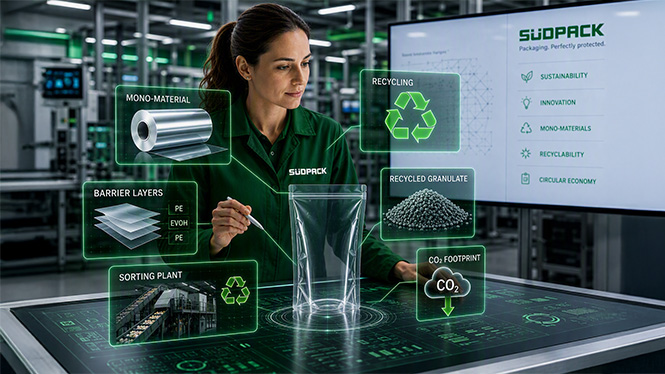
Many products require reliable protection against oxygen, moisture, UV radiation, or aroma loss. Sensitive foods, pet food, and pharmaceutical applications in particular place high demands on the barrier performance of packaging materials.
Traditionally, these requirements have often been met with multilayer material structures. In these structures, each material layer contributes a defined function — whether it is barrier performance, sealability, or mechanical strength.
From a circular economy perspective, however, complex material structures are often more difficult to recycle than mono-material alternatives. Packaging developers therefore have to combine the required protective performance with the highest possible level of recyclability.
Modern mono-material solutions show that this conflict can increasingly be eased. Even so, the challenge remains: the higher the requirements for product protection, the more demanding material selection becomes.
Packaging has to stand out on the shelf and communicate brand messages clearly. Colors, printed graphics, and finishes all play an important role.
At the same time, these design elements can affect sorting later on. Certain dark materials may be harder to detect in some sorting systems. Large-area printing, coatings, or additional components can also influence how packaging is identified during the recycling process.
For packaging developers, this means taking the requirements of sorting and recycling infrastructure into account as early as the design phase. Attractive packaging design and high sortability can often be combined, but doing so requires careful coordination of all components.
Sustainable packaging design therefore does not begin at disposal. It begins with the very first design decisions.
Additives perform many functions in modern packaging materials. They can improve processability, enhance UV protection, provide antiblocking properties, or help support product shelf life.
Every additional function, however, changes the composition of the material. In the recycling process, certain additives can affect the properties of the resulting recyclate.
This does not mean additives are inherently problematic. In many applications, they are essential. What matters is precisely tailoring their function to the application and considering their impact on the material loop early in the development process.
For developers, this creates a demanding balance between functional requirements and the highest possible recyclate quality.
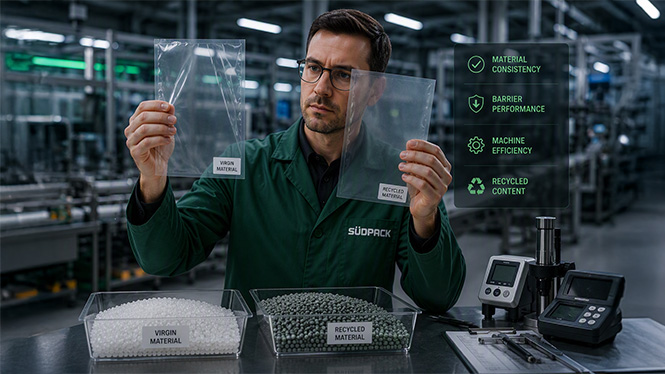
The use of recycled content is becoming increasingly important for many packaging solutions. At the same time, recycled materials introduce new challenges for packaging development.
Unlike virgin materials, recycled materials can vary in their properties depending on their origin and processing. This variability can affect processing parameters, mechanical performance, and visual appearance, among other factors.
For demanding applications, the central question is how a high share of recycled content can be combined with consistent product protection and stable machine performance.
This requires extensive material expertise, precise quality control, and targeted material development. After all, sustainable packaging must not only be recyclable. It also has to perform reliably in real-world applications.
The packaging industry is continuously working to reduce the trade-offs associated with sustainable packaging development.
One key approach is design for recycling. In this approach, packaging is developed from the outset so it can be integrated as effectively as possible into existing sorting and recycling processes.
At the same time, mono-material strategies are becoming more important. They help reduce material variety within a package and enable better use of existing recycling streams.
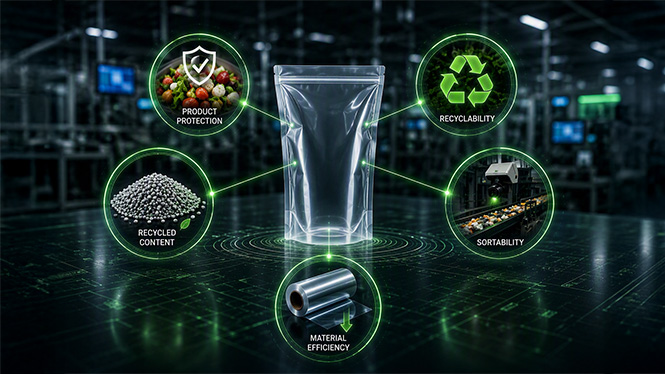
Intelligent compounding opens up additional possibilities. By deliberately combining polymers and functional components, performance requirements can be met without losing sight of circularity. The development of suitable compounds is therefore becoming an important lever for future packaging concepts.
Collaboration across the entire value chain is just as important. Only when raw material suppliers, packaging producers, brand owners, machine manufacturers, retailers, and recyclers work together can existing trade-offs be reduced in a lasting way.

Circularity is a central goal of modern packaging concepts, but it is not the only one.
The reality of packaging development is defined by conflicting goals. Product protection, material efficiency, recycled content, processability, and recyclability all have to be considered at the same time. The best solution is therefore rarely the one that maximizes a single criterion.
Successful packaging emerges when technical performance and sustainability requirements are considered together. This is where the greatest challenges in sustainable packaging development lie — and where the industry’s strongest opportunities for innovation can also be found.
Sustainable packaging has to meet many requirements at once. It must protect products, use resources efficiently, be recyclable, comply with regulations, and remain economically viable to process. This often creates conflicting goals that need to be considered as early as the packaging development stage.
A high level of product protection often requires specific barrier properties against oxygen, moisture, or light. For many years, these functions were achieved through complex material structures. However, such structures can place higher demands on sorting and recycling than mono-material solutions.
Material selection influences nearly every property of a package, from product protection and processability to resource use and recyclability. That makes it one of the most important decisions in the development process.
Certain dark materials can be more difficult for some sorting systems to detect than light-colored or transparent packaging. This is why sortability is increasingly being considered during packaging design.
Printing inks are important for brand presentation and consumer information. At the same time, they can influence sorting and recycling processes. This makes the selection of recycling-compatible printing and decoration concepts increasingly important.
No. The suitability of recycled materials depends on the specific application, the technical requirements, and the available material qualities. Certain applications may involve particularly high requirements for safety, performance, and material consistency, all of which have to be considered during development.
Note: Selected graphics used in this article were created with the support of generative AI.