


SÜDPACK Newsletter
Receive regular updates about SÜDPACK, our products and sustainability topics.
Receive regular updates about SÜDPACK, our products and sustainability topics.
Medical devices are subject to special requirements — and for good reason
In medical technology, packaging is far more than a protective layer. Discover how it helps safeguard patient safety, meet regulatory requirements, and become a decisive factor in the success of medical devices.

How the MDR has changed requirements for medical device packaging
Traceability of medical devices: the importance of UDI
Sterile barrier systems: the invisible protective function
Packaging validation: evidence instead of assumptions
Challenges for manufacturers — and opportunities for innovation
Conclusion
FAQ: Frequently Asked Questions About Medical Device Packaging
Whether catheters, surgical instruments, or implants: medical devices come into direct contact with human health. Any failure can have serious consequences — from delayed treatment to infections or life-threatening complications. That is why manufacturers in the medical technology sector are subject to significantly stricter requirements than companies in many other industries.
Packaging plays a key role in this context. It not only protects the product during storage and transport, but also makes a decisive contribution to patient safety. Today, requirements for medical device packaging range from sterility and traceability to the standards-compliant validation of packaging systems. In addition, manufacturers must comply with regulatory requirements such as the European Medical Device Regulation (MDR) and provisions for Unique Device Identification (UDI).

With Regulation (EU) 2017/745, better known as the Medical Device Regulation (MDR), the European Union has significantly tightened the regulatory framework for medical devices.
The objective is to enhance patient safety and create greater transparency throughout the entire supply chain.
The MDR requires manufacturers to comprehensively demonstrate and document the safety and performance of their products throughout the entire product life cycle.
Packaging is an essential part of the medical device system.
In particular, manufacturers must demonstrate that the packaging:
→ ensures product safety,
→ supports the intended purpose,
→ maintains sterility until the point of use,
→ minimizes risks for patients and users.
As a result, packaging is increasingly moving into the focus of regulatory assessment and becoming an important component of MedTech compliance.
Another key component of the MDR is improved traceability of medical devices. To support this, the Unique Device Identification (UDI) system was introduced.
Each medical device is assigned a unique identifier that enables identification throughout the entire supply chain. The UDI consists of several data elements and can, for example, be applied to the packaging in the form of a barcode or DataMatrix code.
The advantages are clear:
→ greater transparency across the supply chain,
→ improved market surveillance,
→ more effective measures against counterfeit products,
→ greater safety for patients and users,
→ faster product recalls.
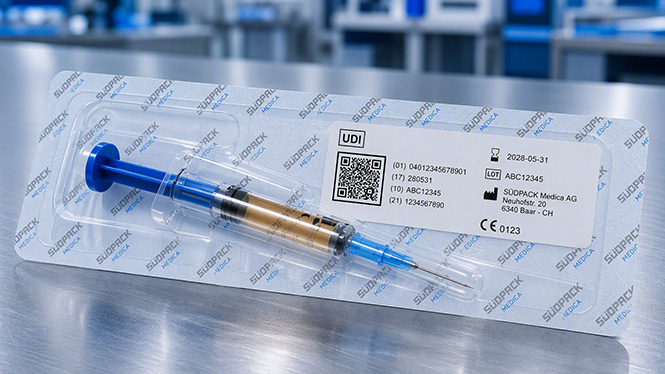
For packaging developers, this means that packaging must do more than provide protection. It must also offer sufficient space and suitable surfaces for labeling that remains permanently legible and compliant with applicable standards.

For many medical devices, sterility is critical. Even the smallest contamination can put patient treatment at risk. This is why sterile barrier systems are used.
A sterile barrier system is the minimum package that enables sterilization and subsequently maintains sterility reliably until the point of use.
Typical requirements for sterile barrier systems include:
- microbial barrier properties,
- high material integrity,
- controlled opening behavior,
- resistance to stresses during transport and storage,
- compatibility with the respective sterilization method.
The packaging must perform not only during manufacturing, but also maintain its protective function throughout the entire intended shelf life.
For manufacturers, this creates a complex task: packaging materials and packaging design must be precisely aligned with the product, the sterilization method, and the supply chain.
In medical technology, it is not enough to assume that packaging will perform as intended. Its performance must be verified and documented. This is precisely where packaging validation comes into play.
The international standard ISO 11607 defines requirements for packaging systems for terminally sterilized medical devices and describes the necessary validation processes.
Among other things, the following aspects are evaluated:
Design qualification: Evidence that the packaging concept can fulfill the required functions.
Process qualification: Verification that packaging machines and processes operate reproducibly and under control.
Performance qualification: Evidence that the final packaging system performs reliably under realistic conditions.
Transport simulations, aging tests, and seal integrity and strength tests are often performed as additional validation measures.
For manufacturers, this involves considerable testing and documentation effort. At the same time, validation provides the necessary assurance for authorities, customers, and patients.
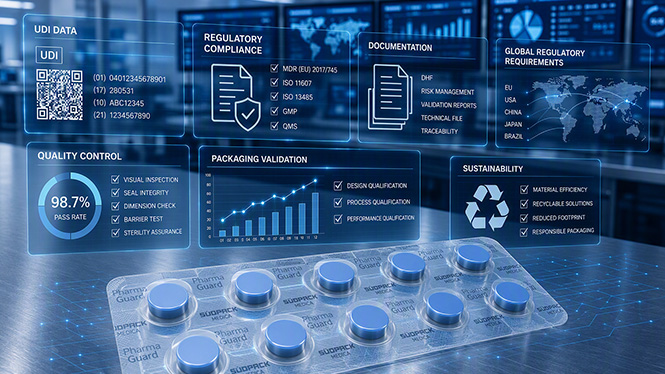
Regulatory requirements continue to increase. At the same time, customers expect efficient processes, sustainability, and the highest level of product safety.
This creates new challenges:
- integration of UDI labeling,
- evidence of regulatory compliance,
- increasing documentation obligations,
- different regulatory requirements worldwide,
- growing demands for material efficiency and sustainability.
At the same time, these developments open up opportunities for innovative packaging solutions.
Modern high-performance films, optimized packaging concepts, and digitalized traceability solutions can help combine regulatory requirements with economic efficiency.
For medical technology companies, packaging is therefore increasingly becoming a strategic success factor — far beyond its traditional protective function.
Today, the requirements for medical device packaging go far beyond protecting a product. Together, the MDR, UDI labeling, sterile barrier systems, and packaging validation form the foundation for safe medical devices.
Packaging is becoming a central element of patient safety and regulatory compliance. Companies that invest early in standards-compliant, validated, and future-ready packaging solutions not only create greater safety, but also lay the foundation for sustainable market success in medical technology.
The Medical Device Regulation (Regulation (EU) 2017/745) defines requirements for the safety, performance, clinical evidence, market surveillance, and traceability of medical devices within the European Union.
It protects the product against damage and contamination, supports the maintenance of sterility, and makes an important contribution to patient safety.
A sterile barrier system is the minimum package of a sterilized medical device that prevents the ingress of microorganisms and maintains sterility until the point of use.
Traceability enables the clear identification of products throughout the entire supply chain and supports product recalls, market surveillance, and patient safety.
UDI stands for Unique Device Identification. It is a standardized system for the unique labeling and identification of medical devices.
Validation demonstrates that packaging systems and packaging processes function reliably and maintain sterility and product safety throughout the entire intended shelf life.
ISO 11607 defines requirements for materials, sterile barrier systems, packaging design, manufacturing processes, and validation activities for terminally sterilized medical devices.
Note: Selected graphics used in this article were created with the support of generative AI.