



SÜDPACK Newsletter
Receive regular updates about SÜDPACK, our products and sustainability topics.
Receive regular updates about SÜDPACK, our products and sustainability topics.
The PPWR introduces new requirements for medical packaging. Why exemptions should not be understood as a general release from obligations — and why manufacturers should start preparing today.
Many manufacturers are currently reviewing which specific PPWR requirements apply to medical packaging. While the regulation provides exemptions for certain contact-sensitive packaging, numerous obligations still apply to the medical technology sector. Documentation, labeling, packaging optimization, and extended producer responsibility (EPR) in particular are increasing the pressure to act. Early preparation is therefore becoming a decisive lever: companies that systematically evaluate recyclable packaging concepts today can limit regulatory risks, better manage future costs, and prepare in time for rising requirements.

Why the PPWR also affects medical technology
Which PPWR requirements apply to medical packaging?
The key tension: safety versus circularity
What role do innovative materials and packaging solutions play?
Conclusion: Why early action can create competitive advantages
FAQ: Frequently asked questions about the PPWR for medical packaging
With the Packaging and Packaging Waste Regulation (PPWR), Regulation (EU) 2025/40, the European Union aims to reduce packaging waste and strengthen the circular economy. In principle, the regulation applies to almost all packaging placed on the EU market — including medical packaging. Contrary to a common assumption, there is no general exemption for medical technology.
The PPWR does provide exemptions for certain contact-sensitive packaging for medical devices with regard to recyclability requirements and minimum recycled content. However, many other obligations remain fully applicable. These include documentation requirements, declarations of conformity, labeling obligations, packaging minimization, and extended producer responsibility (EPR).
For manufacturers of medical devices, this means that the PPWR will become an important component of packaging compliance.
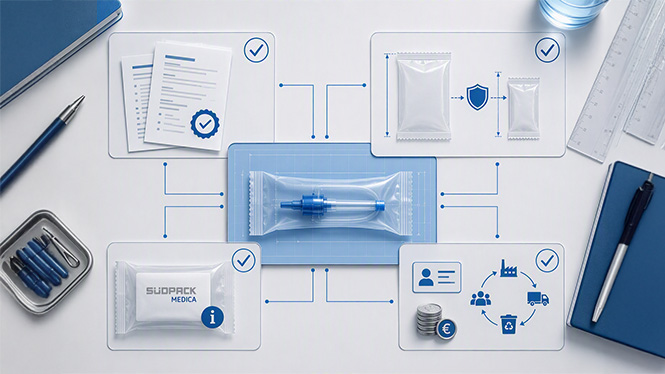
The PPWR introduces new requirements for the technical documentation of packaging. In the future, manufacturers must be able to demonstrate that their packaging complies with the applicable provisions. This particularly includes preparing a declaration of conformity and providing technical evidence.
For medical technology companies, this means additional documentation work, as the requirements of the PPWR must be considered alongside existing regulatory frameworks such as the MDR and quality management systems.
Another objective of the PPWR is to reduce unnecessary packaging volumes. Manufacturers must be able to demonstrate that packaging does not contain more material than is necessary for product protection, transport, and use.
In principle, this requirement also applies to medical packaging. The packaging manufacturer is responsible for demonstrating that the packaging meets the requirements of Article 10 of the PPWR. This evidence is provided through technical documentation and the declaration of conformity; verification takes place as part of market surveillance.
The regulation also includes new labeling requirements that will be introduced gradually. The aim is to provide better information about material composition and disposal routes. Medical packaging is generally covered by these requirements as well, although certain simplifications may apply to particularly sensitive primary packaging.
Extended producer responsibility (EPR) is particularly relevant for manufacturers of medical devices. Companies that place packaging on the market must register, report data, and make financial contributions to collection, sorting, and recycling systems.
The key point is this: anyone who places packaging on the market also assumes responsibility for its end-of-life phase. Responsibility therefore does not end with the sale of the product, but also includes the financing of downstream disposal and recycling structures.
It is also important to note that the planned exemptions for contact-sensitive medical packaging do not release companies from EPR obligations. The obligation to pay fees remains in place. This creates direct economic pressure for companies: packaging designed for recycling and capable of supporting high-quality recovery routes will become more attractive not only from a regulatory perspective, but also from a financial one. EPR is therefore evolving from a pure disposal fee into an important steering instrument for circular packaging design.
The PPWR acknowledges that certain packaging in the medical sector does far more than transport a product or provide information. For packaging that plays a significant role in product protection, sterility, patient safety, or the preservation of critical product properties, time-limited exemptions therefore apply. This particularly concerns contact-sensitive packaging for medical devices under the MDR (EU 2017/745) and in-vitro diagnostics under the IVDR (EU 2017/746).
Based on the current provisions, these exemptions mainly relate to primary packaging and certain packaging systems that are directly relevant to the product. They should not be interpreted as a blanket exemption for all packaging components. Instead, a case-by-case assessment is required, based on Article 6 of the PPWR and the specific function of the respective packaging.
Article 6 of the PPWR defines the requirements for the recyclability of packaging. The objective is to design packaging so that it can be effectively collected, sorted, and recycled within existing systems.
What is especially important for manufacturers of medical devices is that these exemptions are not intended to be permanent. The European Commission must review the provisions by January 1, 2035 and evaluate whether they remain justified. Under the current exemption, the affected packaging may continue to be placed on the market even if it does not meet recyclability requirements. At the same time, the review clause clearly indicates the regulatory direction: the recyclability of medical packaging will move increasingly into focus over the long term.

For manufacturers of medical devices, patient safety remains the top priority.
Sterile barrier systems must reliably demonstrate that they maintain a product’s sterility and protective function throughout its entire life cycle.
The requirements of ISO 11607 for material properties, process reliability, validation, and traceability will therefore remain the key foundation for packaging development.
The PPWR does not change this. Rather, it encourages companies to look for more sustainable solutions wherever these can be reconciled with the high requirements for product protection, sterility, and safety. Instead of viewing safety and sustainability as opposites, manufacturers should systematically evaluate which alternative materials, mono-material concepts, or more recyclable packaging solutions are already available today or suitable for their specific applications.
At the same time, the market continues to evolve dynamically. Many companies are working on new material and packaging concepts designed to combine high protection requirements with improved recyclability.
The task, therefore, is not to compromise on patient safety, but to identify the areas where product protection and sustainability can already be successfully aligned today — while preparing targeted solutions for the future.
The development of future-oriented medical packaging will be shaped to a significant extent by new material concepts.
The focus is on:
→ material-efficient packaging concepts,
→ reduced material thicknesses,
→ recycling-oriented mono-material structures,
→ improved separability of individual packaging components,
→ solutions based on certified circular raw materials,
→ new approaches based on chemical recycling.
Technical performance remains decisive. Materials must continue to withstand sterilization processes, ensure the integrity of the packaging system, and meet all regulatory requirements.
Long-term success will therefore depend above all on solutions that consider product protection, patient safety, recyclability, and economic requirements together.
For medical packaging, the PPWR is far more than a sustainability topic: it is becoming a central compliance factor for the entire MedTech industry.
While exemptions currently apply to certain contact-sensitive packaging with regard to recyclability and recycled content, many requirements already apply today or will become relevant in the near future. These include documentation and conformity obligations, labeling requirements, packaging optimization, and EPR responsibility.

That makes early action all the more important. The current exemptions will be reviewed no later than 2035 — and manufacturers that wait until then may lose valuable time. Companies that assess their packaging systems today in terms of material efficiency, recyclability, and future regulatory readiness create stronger conditions for long-term competitiveness and cost control.
The PPWR also applies to medical packaging. In the future, manufacturers will need to meet documentation obligations, labeling requirements, packaging minimization rules, and EPR requirements, among other provisions. However, certain contact-sensitive packaging is temporarily exempt from individual requirements.
Yes. Packaging for medical devices falls within the scope of the PPWR. However, exemptions apply to certain contact-sensitive packaging with regard to recyclability and recycled content. There is no full exemption.
Contact-sensitive packaging for medical devices and in-vitro diagnostics is currently exempt from recyclability requirements under Article 6 and from minimum recycled content requirements under Article 7. The European Commission must review these exemptions by 2035.
Manufacturers must provide technical documentation and prepare a declaration of conformity for their packaging. This evidence is used to demonstrate compliance with PPWR requirements to authorities and market surveillance bodies.
Note: Selected graphics used in this article were created with the support of generative AI.